
Xinhua Headlines: China speeds up green transition, helping build clean, beautiful world
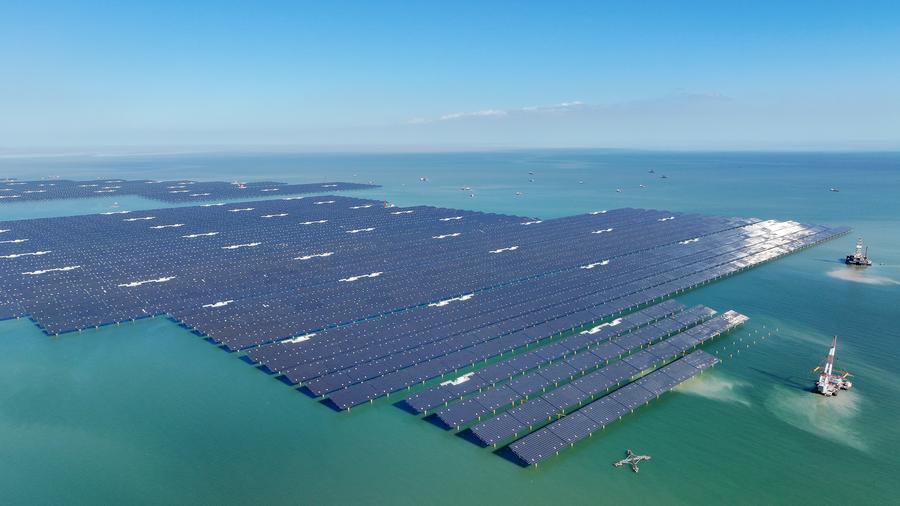
An aerial drone photo taken on 泗县妇联新闻网首页网址Nov. 13, 2025 shows an offshore photovoltaic project in Dongying City, east China's Shandong Province. (Photo by Zhou Guangxue/Xinhua)
In China, the world's largest electricity consumer, one in every three kilowatt-hours of electricity comes from green energy sources, powering daily life, while reshaping the national and global energy and industrial landscapes, according to the National Energy Administration.
BEIJING, Jan. 24 (Xinhua) -- After withdrawing from the Paris Climate Agreement for a second time last year and declining to send a delegation to the 30th United Nations Climate Change Conference (COP30) in Brazil, the U.S. administration announced earlier this month its intention to exit the UN Framework Convention on Climate Change -- delivering yet another blow to global climate governance.
By contrast, defying global headwinds, China has accelerated its green, low-carbon transition, putting in place the world's most complete policy system on reducing carbon emissions and building the world's largest renewable energy system.
As a global leader in renewable energy, China's green production capacity not only enriches its own energy supply, but also creates broad opportunities for Global South countries to achieve low-carbon, leapfrog development, helping build a clean and beautiful world.
REMARKABLE STRIDES
In China, the world's largest electricity consumer, one in every three kilowatt-hours of electricity comes from green energy sources, powering daily life, while reshaping the national and global energy and industrial landscapes, according to the National Energy Administration (NEA).
China has ranked first worldwide in installed wind power capacity for 15 consecutive years. By November 2025, its total installed capacity had exceeded 600 million kilowatts (kW), far exceeding that of any other nation, official data show.
With vast onshore wind farms across its northern and western regions and rapidly expanding offshore projects along the eastern coastline, China's wind energy not only provides clean electricity to millions of households but also plays a crucial role in reducing carbon emissions.
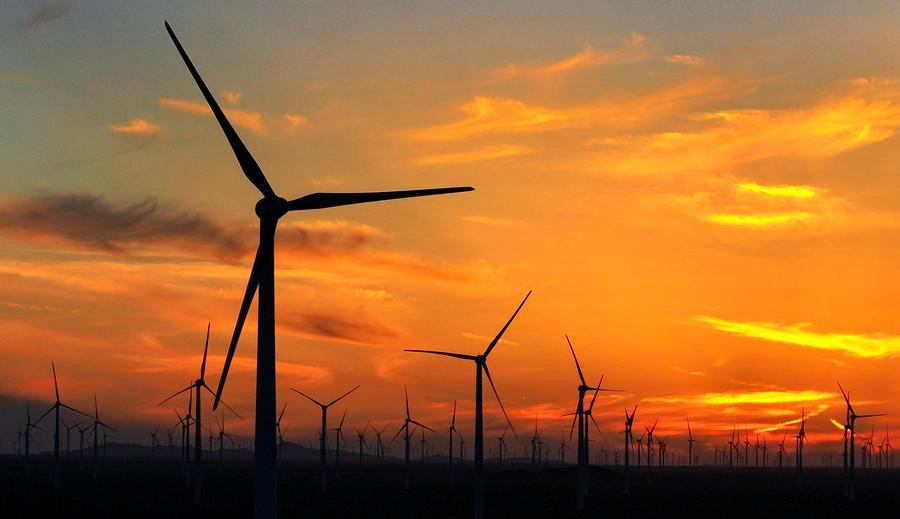
A drone photo taken on Sept. 10, 2024 shows a view of the Santanghu wind power farm in Hami, northwest China's Xinjiang Uygur Autonomous Region. (Xinhua/Hu Huhu)
Northwestern Chinese regions like Qinghai, Xinjiang and Ningxia have turned their sunbaked, wind-swept deserts into treasure troves of green power through large-scale solar development, while coastal provinces like Guangdong, Jiangsu and Shandong are scaling up offshore wind power clusters to meet high electricity demand.
China's total installed power-generating capacity reached 3.79 billion kW by the end of November 2025, marking a 17.1 percent year-on-year increase, according to the NEA. Solar power capacity led the growth with a 41.9-percent year-on-year surge to 1.16 billion kW, while wind power capacity expanded by 22.4 percent to 600 million kW.
Yao Shangheng, a researcher at the Energy Development Research Institute under China Southern Power Grid Co., Ltd., said that China has built the world's largest and most integrated renewable energy system, with complete industrial chains.
Its outputs of PV polysilicon, wafers and cells account for 90 percent of the global total, with its module outputs accounting for about 85 percent of the global total.
China is also spearheading cutting-edge technology. Recently, a Shanghai start-up announced a breakthrough in creating sustainable aviation fuels (SAF).
Using high-performance catalysts, the method converts carbon dioxide and green hydrogen produced from water electrolysis into liquid fuels, primarily hydrocarbons.
Song Xuefeng, the project's manager and vice president of Shanghai Airport (Group) Co., Ltd., said the one-stop synthesis process consumes less energy than alternatives. "Electrolysis can tap low-cost wind and solar power in northwest China to yield high-value, storable and transportable clean fuels," he said.
COMMENDABLE CONTRIBUTIONS
"Two years ago, there was nothing here but barren hills and the wind blowing dust everywhere," recalled Sarvan Gahramanov, a civil engineer with PowerChina Huadong Engineering Corporation Limited (HDEC).
Standing at the booster substation of a new wind farm in eastern Azerbaijan, he looked up toward the ridgeline -- one now dotted with towering white wind turbines.
As one of local engineers engaged in the site's transformation, Gahramanov has witnessed every stage of the 240-megawatt Khizi-Absheron Wind Power Plant's construction. The Chinese-built project's commissioning was described by Azerbaijani President Ilham Aliyev as a milestone in the energy sector of Azerbaijan, a nation targeting a 30 percent share of renewable capacity by 2030.
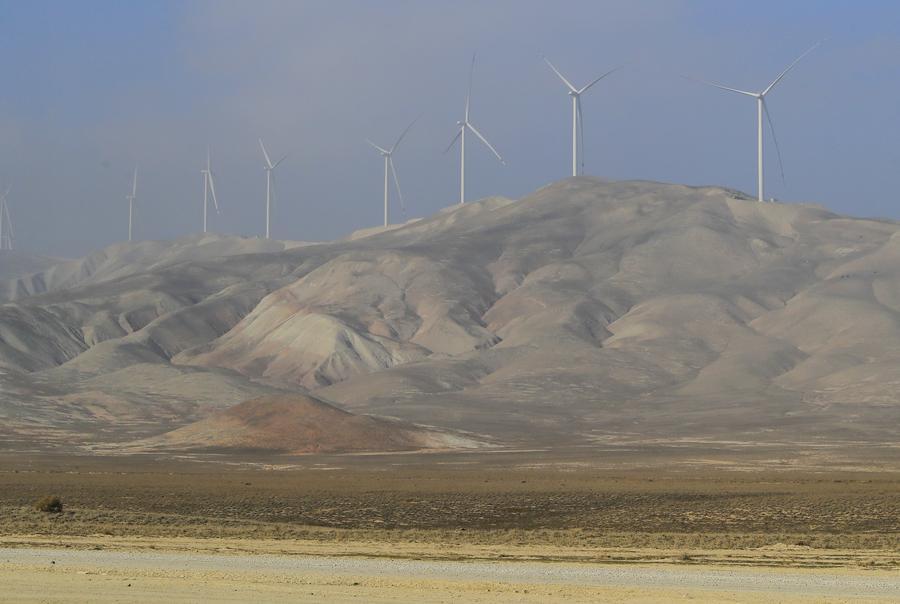
This photo shows the Khizi-Absheron Wind Power Plant in Azerbaijan, Jan. 8, 2026. (Xinhua/Chen Junfeng)
This is only one example of how China has shared its green achievements beyond its borders. During the 2021-2025 period, the wind power and photovoltaic products China exported helped reduce around 4.1 billion tons of carbon emissions in other countries, official data show.
China's new energy products and technologies, which are of high quality and affordable, meet the urgent need of developing countries for sustainable and affordable energy, offering a viable alternative to fossil fuels and paving a new path towards green development.
In Jordan, the country's cooperation with China on green energy is helping Jordan's Economic Modernization Vision for 2023-2033, which aims to spur growth, create jobs and reduce reliance on imported energy.
Firas Blasmeh, a member of the Jordanian energy and environment association, said Chinese firms are increasingly active across the sector, from renewable power projects to equipment supply and electric transport.
"They combine technical expertise with flexible financing and fast execution," Blasmeh said.
Thong Mengdavid, deputy director of the China-ASEAN (Association of Southeast Asian Nations) Studies Center of the Cambodia University of Technology and Science, said that the renewable energy equipment produced by China has driven down costs for solar, wind and battery technologies sharply over the past decade.
"It is also helping ASEAN expand renewable power generation, smart grid integration and electric mobility infrastructure. Such cooperation supports ASEAN's commitments under the United Nations Sustainable Development Goals (SDGs), while positioning the region to benefit from the global transition to a low-carbon economy," Mengdavid said.
Georg Pflomm, the project manager at the Competence Center for Energy, Environment and Sustainable Economy of AHK Services Eastern Africa Ltd., said that Chinese-manufactured solar products have boosted energy diversification and security on a continent keen to advance low-carbon growth.
Across the globe, models such as "photovoltaics plus agriculture" and "small hydropower plus aquaculture" have alleviated the problem of insufficient electricity in rural Africa, and also improved people's livelihoods.
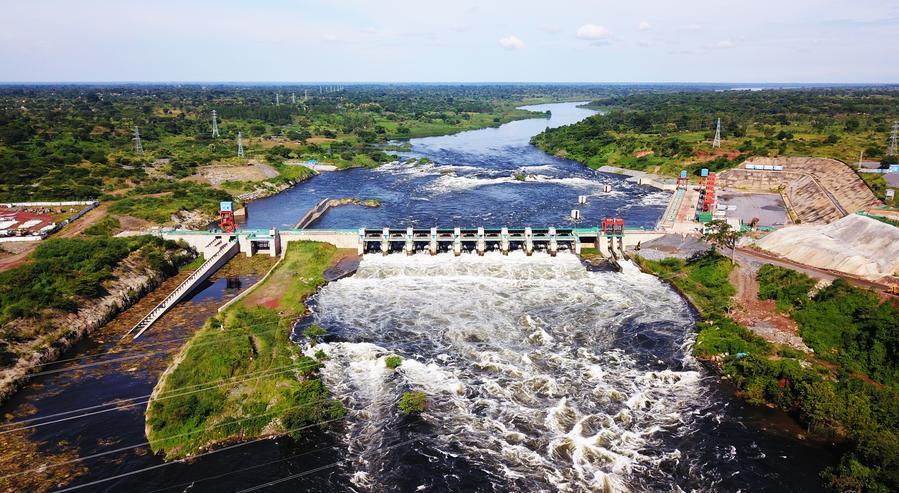
Aerial photo taken on July 11, 2020 shows the Karuma hydropower project under construction along the River Nile in Kiryandongo.district of Uganda. (Photo by Jia Junwei/Xinhua)
The U.S. academic journal Science named the renewable energy surge as the 2025 Breakthrough of the Year, noting that China's mighty industrial engine is the driver.
Quoting the Britain-based Carbon Brief, it said solar panels, batteries, electric vehicles and wind turbines exported from China in 2024 are set to cut annual CO2 emissions in the rest of the world by 1 percent.
Official data showed that during the 2021-2025 period, wind power and photovoltaic products China exported helped reduce around 4.1 billion tons of carbon emissions in other countries.
Also, Chinese firms have pledged roughly 200 billion U.S. dollars in overseas clean energy investments since 2022, reported The Wired in December, saying that this is "beginning to narrow the gap in funding needed to slash the world's climate pollution."
Maroun Kairouz, managing director of the World Economic Forum (WEF), told Xinhua recently that China's massive investment in advanced manufacturing and green technology demonstrates how innovation can be deployed at scale.
"China's strengths in green technology and advanced manufacturing play a vital role in addressing the dual challenges of climate change and supply chain instability," he said.
"China's principle of integrating industrial, digital, and climate strategies with skills development offers valuable lessons for other emerging markets," he said.
(责任编辑:休闲)
- 腾讯视频《奋斗吧人生
- 华龙洞遗址考古发掘成果展在池州市博物馆开展
- 王力宏出轨的已婚女人是谁?徐若瑄凌晨发文辟谣
- 脱下工装,穿上球衣!广东工会“工BA”职工篮球联赛佛山开波
- 新春逛黄山许村:诗书传家,古村有戏更有味
- 赏花游、亲子游成清明游热点 “拼假”4天以上人次大增
- 8月27日首届中国医师节·京沪豫三甲名医团郑州长江医院巡诊—中医不孕不育专场
- 全球新能源发展进入加速期
- 暌违三年,热爱回归!|2026余景天「Echo Pulse 脉浪回响」巡回演唱会首站上海站正式官宣!
- 铜陵市开展文物普查 保护文化遗产
- 中国市场买不到!三星电子连发四款显示器
- 芜湖市国庆长假乐不停7天将举行12场文艺活动
- 跨境电商发展更具新活力(消费万花筒)
- “澳车北上”累计突破500万辆次
- 传统文化“点亮”创意开学礼
- 摩尔线程推出云边端产品:用尽全力打造成熟AI生态
- 2024济宁月子中心价格表出炉,想知道任城区哪家好看这
- 南方科技大学计划在豫招60人 4月30日报名截止
- 前11个月民企享受新增减税降费政策占比超七成
- 郑州一企业对抗执法撕掉封条转移设备 警方已介入
- 临沂新闻网红名单最新 views+
- 深圳新闻网骗局曝光事件 views+
- 东莞海城新闻网首页官网 views+
- 内蒙古新闻网2015 views+
- 沂南水利新闻网招聘信息 views+
- 宁明海淵贩毒新闻网 views+
- 黄河新闻网张向斌 views+
- 大塘镇 头条新闻网 views+
- 合肥高铁站新闻网 views+
- 威宁新河街道新闻网首页 views+