

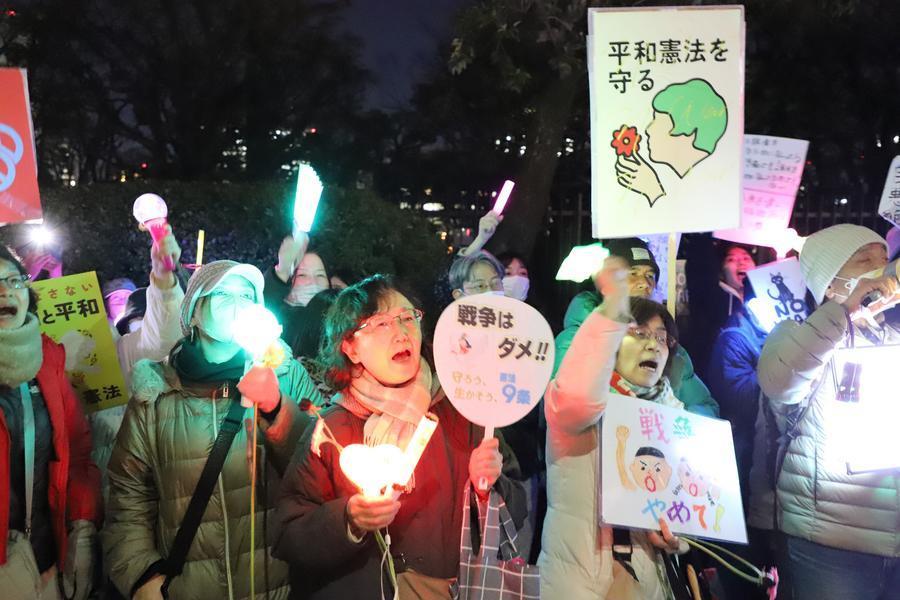
Demonstrators attend a rally outside the National Diet in Tokyo,上海交通实时新闻网 Japan, March 10, 2026. (Xinhua/Li Ziyue)
The crime should hardly be dismissed as an "isolated public security incident." Rather, it exposes deeper undercurrents within Japanese society and its military institutions: a convergence of ideological distortion, political radicalization, and institutional complacency.
TOKYO, March 31 (Xinhua) -- A shocking incident involving a young officer of the Japan Ground Self-Defense Force (GSDF) has sent ripples far beyond a mere security breach, after he scaled a barbed-wire wall and broke into the Chinese Embassy last week with an 18-centimeter blade, vowing to kill Chinese diplomatic personnel "in the name of god."
The Japanese police filed the case only under the minor charge of "unlawful entry." Senior officials, including the defense minister, offered nothing more than a perfunctory expression of "deeply regrettable."
However, the crime of Kodai Murata, a 23-year-old GSDF second lieutenant, should hardly be dismissed as an "isolated public security incident." Rather, it exposes deeper undercurrents within Japanese society and its military institutions: a convergence of ideological distortion, political radicalization, and institutional complacency.
According to Japanese media reports, Murata has recently graduated from the GSDF officer candidate school, an institution intended to train the backbone of Japan's military and now observed to be a breeding ground for historical revisionism.
Textbooks used at the school in 2024 were reported to describe the Battle of Okinawa in terms of "Japanese forces fighting bravely for a prolonged time," while omitting references to atrocities committed by Japanese troops against local civilians. The school later made partial revisions under public pressure.
At the core of the issue lies the enduring influence of the so-called "Yasukuni historical view," a narrative that whitewashes and distorts Japan's wartime aggression.
At institutions such as the National Defense Academy of Japan, a primary source of SDF officers, cadets have reportedly participated in marches culminating in visits to the Yasukuni Shrine, a symbol of Japanese militarism where 14 Class-A war criminals are enshrined, under the guise of "building physical and mental fortitude." Such practices risk normalizing a revisionist understanding of history among future military leaders.
This internal ideological conditioning has evolved alongside an increasingly right-leaning political climate. In recent years, right-wing forces in Japan have pushed for the relaxation of restrictions on arms exports and the acquisition of "counterstrike capabilities," moves seen as eroding the spirit of Japan's pacifist constitution. Since taking office, Prime Minister Sanae Takaichi has accelerated this trajectory.
The interplay between political messaging and social trends has created a volatile environment.
The embassy intrusion thus appears not as the product of one individual's extremism, but as the cumulative outcome of long-term ideological influence. The parallels with Japan's militarist past are difficult to ignore.
This incident underscores a broader warning. When armed personnel begin to challenge diplomatic norms and constitutional principles, the risk is no longer that of a rare "black swan" event, but of a systemic problem looming on the horizon.
The international community would do well to remain vigilant. History has shown that the resurgence of militarist thinking rarely announces itself loudly at first, but its consequences can be far-reaching.


